
Learning Beyond the Classroom: Reflections from Nan Province
Published on August 9, 2026
Eaint Mo Co, Haemar Ba Kyu
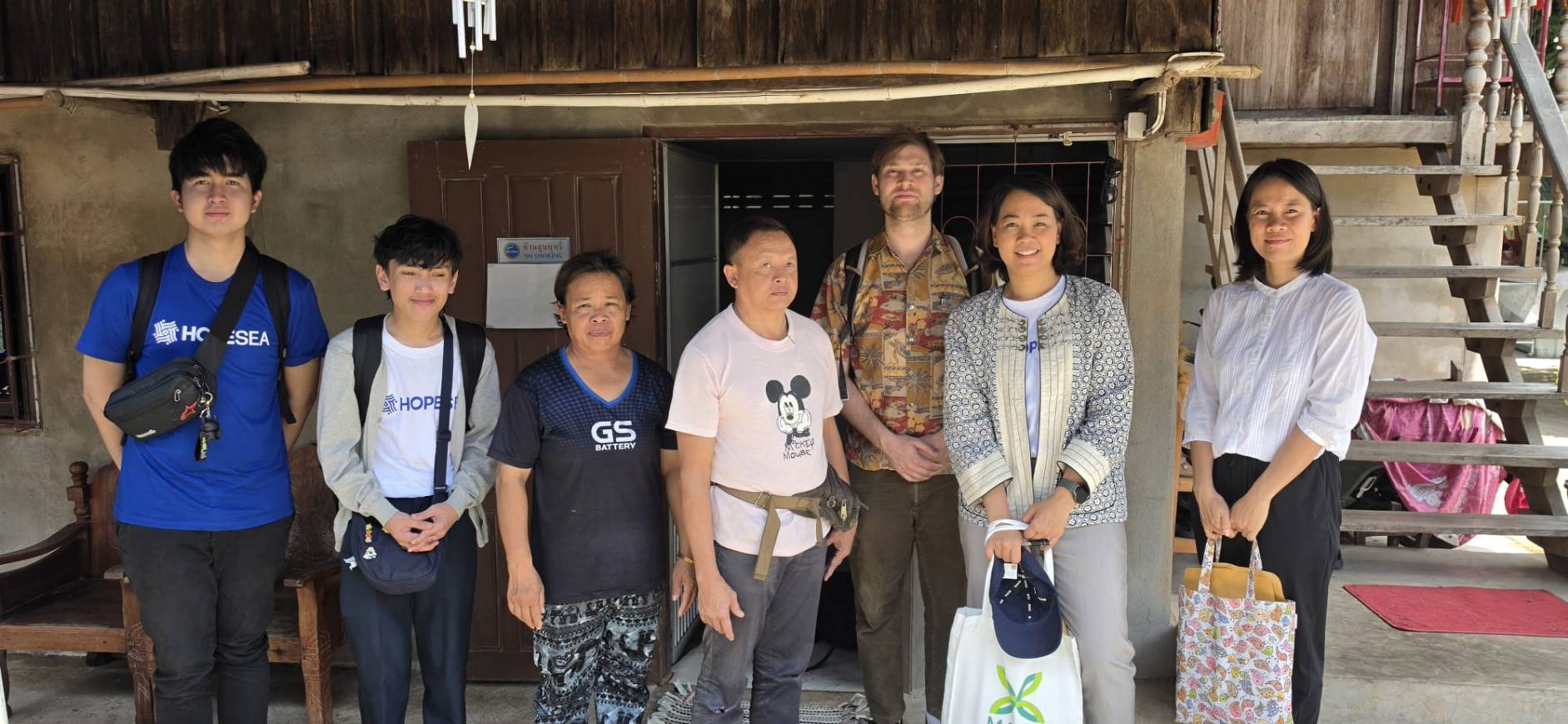
For Henry Williams, a research fellow from Cornell University, and Adam Nurirfan Bin Jefri and Mohamad Shahrun Bin Abdul Ghani, two student interns from the University of Brunei Darussalam, a week of fieldwork in Thailand’s Nan Province became far more than an academic exercise. Their internship period is from mid-May until early September.
Working alongside researchers from the Humanitarian Observatory for Policy and Education in Southeast Asia (HOPESEA) under the Inclusive Signals: Designing Accessible Early Warning Systems in Southeast Asia (IN-SIG) project, supported by the United Nations Office for Disaster Risk Reduction (UNDRR), they stepped into communities where conversations about climate change were no longer theoretical. Instead, they were grounded in people’s lived experiences of floods, preparedness, and resilience.
Although they arrived from different academic backgrounds and perspectives, they left Nan, which is one of the study sites of the IN-SIG project, with a shared appreciation for the human side of disaster risk reduction.
Stepping Beyond the Classroom
For Henry, who is pursuing a Master of Public Administration at Cornell University, the experience marked his first exposure to community-based field research.
“In my program at Cornell, we do research analysis but we don’t usually conduct fieldwork ourselves,” he explained. “Being with the Thai PhD students and seeing how they conducted interviews left a really strong impression on me. I don’t think I’ll forget that experience.”
For Adam and Shahrun, whose backgrounds are in General Engineering, concentrating in Energy Systems, and Information and Communication Systems respectively, the experience offered a very different perspective.
“I wanted to step outside my comfort zone,” Adam said. “Most engineering students spend their time behind computers designing technical solutions. I wanted to experience something completely different.”
For Shahrun, the people he met made the fieldwork experience unforgettable.
“One of the most memorable parts of the fieldwork for me was meeting people from different backgrounds, such as older women, teenagers, people with disabilities and government officials. As it was my first time conducting fieldwork, every conversation broadened my perspective and showed me how much there is to learn from engaging with diverse communities.”
When One Conversation Changes Everything
Among the many conversations held throughout the week, one interview stood out for both Henry and Adam. It was a conversation with a man who is blind, living in a village along the Nan River that had experienced severe flooding the previous year.
Henry admitted he expected the interview to focus on barriers and vulnerability. Instead, it challenged his assumptions.
“He was actually very capable of responding during the flood because he uses accessibility features on his smartphone. The emergency messages were read aloud to him, so he was well prepared.”
The conversation shifted his thinking almost immediately.
“It made me think about people living in more remote villages who don't have access to smartphones or reliable internet. Technology can work remarkably well but only if people can actually access it.”
For Adam, the interview fundamentally changed the way he thought about engineering solutions.
“As an engineering student, I usually think about disaster preparedness in technical terms, such as sensors, equipment, and technology. But after speaking with the community, I realized that technology isn’t the biggest challenge. What’s more important is whether people understand the warning, trust the information, and know what to do.”
The experience reinforced one of the central ideas behind the IN-SIG project: effective early warning systems depend not only on technology but also on accessibility, trust, communication, and community engagement.
Lessons from the Field
More than the surveys or focus group discussions, one aspect of the fieldwork stood out to Henry: the relationships built with communities.
Watching local researchers communicate in the Northern Thai dialect, adapting naturally to each community, demonstrated how trust can shape the quality of research itself.
“The PhD student I worked with spoke the Northern dialect throughout the interviews, and I think that made people feel much more comfortable. It helped remove the barriers between researchers and the community.”
He also noticed how experienced researchers resisted the urge to interrupt.
“Sometimes giving someone a little more space allowed them to share something they otherwise wouldn’t have said. Those honest conversations may not always appear in the survey results, but they still shape how we understand a community.”
Shahrun also came away with similar lessons.
“I learned that researchers need patience and empathy. Building trust and listening carefully helps participants feel comfortable sharing honest perspectives, while recognising that everyone’s experiences and backgrounds are different.”
Together their experiences reinforced that effective research begins with listening, mutual respect and meaningful engagement with communities.
From Fieldwork to the Future
Coming from engineering, Adam and Shahrun both expected technology to be the centre of disaster preparedness.
Instead, they discovered that people were.
“You can’t design a solution by only thinking about the technology,” Adam reflected. “You also have to understand how people will actually use it.”
Shahrun echoed that perspective.
“An early warning system alone is not enough. Communities also need clear guidance on what to do afterwards. Technology, communication, preparedness, and local implementation all have to work together.”
The experience encouraged both students to think differently about their future careers.
Adam now hopes to integrate people-centred thinking into engineering design, while Shahrun is increasingly interested in combining information and communication systems with community resilience and public safety.
Growing with HOPESEA
Beyond the fieldwork itself, they also reflected on the collaborative research environment with HOPESEA.
For Henry, the experience was defined by mentorship and intellectual exchange.
“I hadn’t done fieldwork research like this before so it was new to me. The team was incredibly welcoming to me, especially the PhD student I worked with. She was very patient and took the time to help me understand what we were doing. It was a really positive experience.”
Adam found HOPESEA’s flexible research environment refreshing.
“It was very different from my previous internship. We had the flexibility to manage our own work while meeting regularly with the team. It created a really comfortable learning environment.”
Shahrun echoed those sentiments, highlighting both the team’s openness and the friendships that developed throughout the internship.
“The research team was very friendly and supportive. They created an open environment for us where we can share ideas after every interview or focus group discussion, making the experience both enjoyable and unforgettable.”
Why HOPESEA?
For Henry, one of the most rewarding aspects of the fellowship was contributing to research with real-world impact.
“Southeast Asia is one of the regions most affected by climate change, making it one of the most important places for disaster risk reduction and climate policy research. If you’re interested in this field, the research being done here is unique, and it’s exciting to be at the forefront of it.”
Adam believes the experience is especially valuable for students looking to broaden their perspectives, and embrace the unfamiliar.
“If you’re an engineering student, it definitely won’t be your comfort zone - and that’s exactly why it’s worthwhile. You learn to work with communities and understand how people will actually use the solutions you design.”
Shahrun sees HOPESEA as an opportunity to grow both academically and personally.
“If you want to explore humanitarian issues, climate change, and community research, it’s a great opportunity. You get to combine research with fieldwork, learn from experienced researchers, and engage directly with communities. This also helped me become more confident in communicating with others and building meaningful connections.”
Although they came to HOPESEA from different countries and academic backgrounds, they left with a shared understanding that effective disaster preparedness depends not only on technology but also on trust, communication, and meaningful engagement with communities. Their experiences reflect HOPESEA’s commitment to interdisciplinary collaboration, community-centred research, and preparing the next generation of researchers to address complex humanitarian challenges across Southeast Asia.
If you are interested in this kind of research internship or fellowship, please contact us at [email protected]