
The Ash and the Architect
Published on April 5, 2026
Peter & Thet Oo
For five years at Myanmar's only forestry university, I was trained to be an architect of the forests. I learned about forest management, ecosystem restoration, and rehabilitation. My education focused on grand visions — reforestation, conservation, and technical solutions — while largely ignoring the role of indigenous knowledge in adapting to climate change and living with nature.
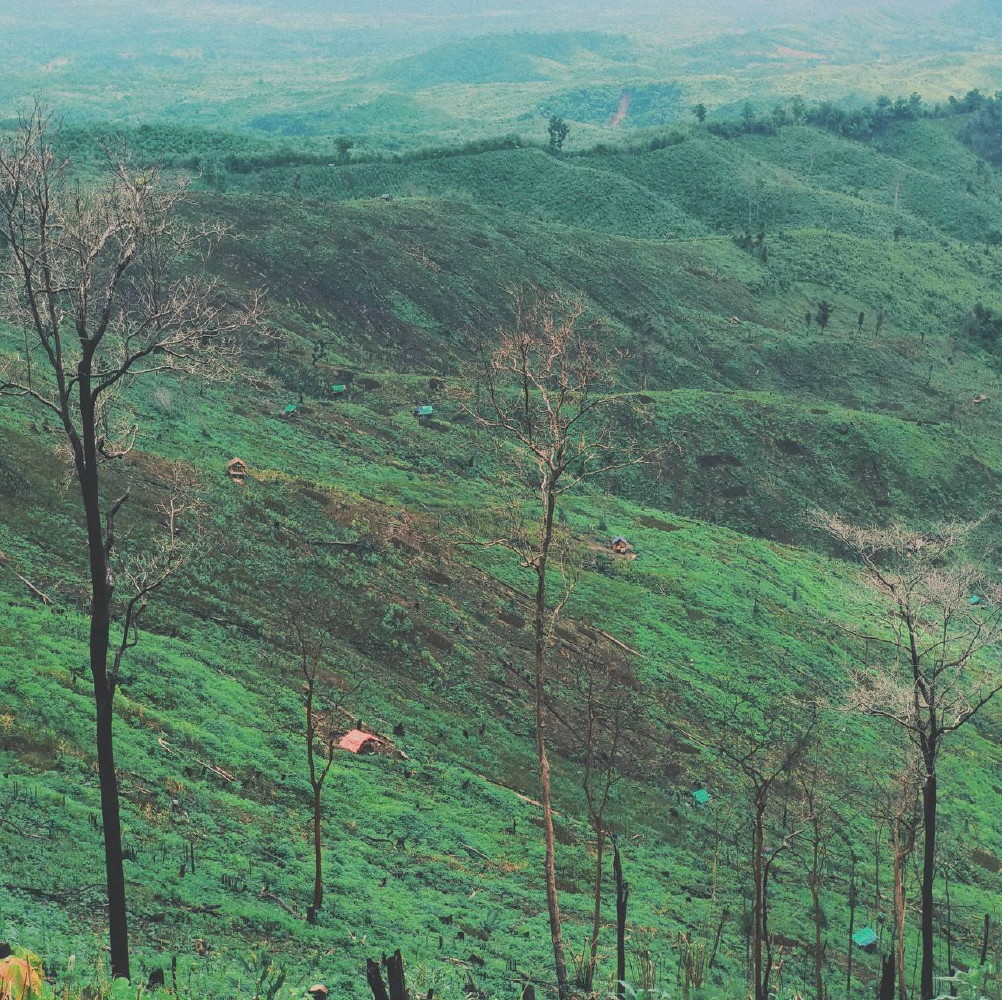
In 2018, I wrapped my uniforms, shouldered bandages, shiny belt with a rectangle logo of tree and deer in it, along with books of forest, which I believed as a weapon to fight for my long journey of working in the tropical forest of Magway region. I was assigned for the mission to implement a commercial teak plantation under "Myanmar Reforestation and Rehabilitation Program (MRRP)" in the region as a plantation manager.
Being a fresh forester, I reckoned myself full of energy, courage, and a man full of different perspectives which are then to be shared with local people in or nearby forest, who spend all their life in the place they born and to die. I joyed of keeping my uniform hat either in my arms or on my held-up head, leaving my footsteps everywhere in the 200 acres of commercial plantation I was taking lead. My team consisted of five forestry staff and fifty villagers, each family growing four acres of chili and sesame between young teak trees during the first year.
Forest plantation success relies on community participation and mutual benefit: the department gains affordable labor, while communities secure short-term income through intercropping in the first year. Yet I still believed I was the teacher, and they were the learners. I brought technical advice to their fields, convinced that my knowledge would guide them to higher yields and a successful plantation.
Upon joining as a plantation manager, their full attention was on me with eyes full of curiosity, suspicion, astonishment, and even disdain to this very lad they would rely on for a whole year. However, I brought my technical expertise to every corner of their yards, offering insights to improve crop yields without compromising the success of the plantation.
Over the journey of my 2018 plantation went very well, as I could see the spout of leaves at the top of my baby teak and of course, as well on their baby chili and sesame. This was me who made this happen, this was them who followed my lead, this was my team who put their trust in me. I was fooled by my own illusion, I was full of delusion, my visions blurred with my arrogance for the past 6 months.
I dwelled in a nearby village, from where 50 villagers did hike up in the morning to my plantation, to where they hiked down in the evening for their loved family. Mid between June and July, downpouring scattered through the vicinity of the Magway forest, the water filled every single cup within the forest: the bump on the path, the knot of the trees, pond of the shallow field, escalating the speed of the springs spanning across the mountains.
I was dipping in the bed sheets, feeling under the weather from late-night paperwork and reporting. I woke to the nagging of a child downstairs of my long-legged attap house, asking his mom to leave early for bathing in the spring behind the village. My phone screen showed 5:30 AM, I took a sip of water, stepping down by the ladder, when the mom, my tenant, greeted with big smile of "Did we wake you up?".
I replied, "This is good timing to leave for the forest and after all, I am getting up to prepare." She giggled and said, "I will accompany you after taking a bath since none of your villagers were here as they gone for plantation since long before you wake up." She added, "Let's head to the spring to wash your face and I am washing my clothes meanwhile."
At the bank of the spring, she took a handful of ashes out of her clothes, thoroughly splattering over the bunch of clothes, dipping and washing under the spring water thereafter. A mountain of foam rises over her clothes, and I was amazed to learn that they use such magical ash as the way we use detergent. Fancy toothpaste and facial foam in my hand are not sure to be good for the spring water, but I am sure those ashes in her hand bring no harm to the lives under the spring water.
Not very long after my thought, the mom shout out to her kid disporting in water by the shore, and me washing my face by the bank, as a warning call to step back away from the stream since she knew that the water level was going to rise and the flow to be rough within a few seconds after a thunderous call of nature in the upstream.
On our way back, the kid protruded his cute little face. The mom put some ashes on his bumped bruise on his forehead which he sustained a couple of days ago from slipping from the trees. I was amazed at how the ash could help them in several ways in their life, and I carried my amazement back to the attap house for breakfast. I offered to help prepare breakfast, knowing she was making my favorite leaf soup. As I stood beside her setting the table, I saw that she put the same leaves over ashes in the soup as the only ingredient for such a delicious meal.
On my step to plantation, I felt my certainty collapse.
I had believed my technical knowledge would teach these people how to survive climate change. Instead, their indigenous knowledge taught me how to live with nature — without polluting water, without wasting resources, without destroying soil.
They were adapting. I was only managing.
I was a follower, I was a late shower, I was a free rider, my lifestyle was not environmentally friendly, and my over five years of knowledge was nothing compared to their lifelong indigenous knowledge. I was a tiny pond in the forest, while they are flowing like a river.
That morning, as I walked toward the plantation, I no longer felt like a leader. I felt like a student.
My teachers were waiting for me.