
The Village I Once Called Home
Published on April 5, 2026
Author Anonymous
"This land raised us. How can we just leave it behind?"
That was the question my father whispered the day we were told our village was no longer safe to live in.
But by then, the decision had already been made for us.
I grew up in the eastern part of Myanmar, a quiet green village where life moved gently with the seasons. From a very young age, I felt I belonged to that place as much as the trees and the flowing stream did.
When I was six years old, my mornings began before the sun rose. I followed my parents to the rice fields while the air was still cool and the mist floated above the farms. While they worked, I wandered freely along the edges of the fields, my feet muddy and my heart light.
The farms were my favorite place in the world.
Everywhere I looked, there were endless shades of green: rice plants swaying softly in the wind, tall trees standing proudly against the sky, and wild grasses dancing under the warm sunlight. The wide-open space made me feel free. I always preferred being outside in the fields rather than staying inside the house.
Sometimes I carried a small pencil and tried to draw what I saw around me. I was never very good at drawing, but every picture I made had the same things: big trees, distant mountains, a pond or stream, and wide green grass stretching across the land.
Those drawings were my small way of holding on to the beauty of my village.
Back then, I believed I would spend my whole life there.
I imagined myself growing old in that same place, watching my hair slowly turn gray while the mountains stood unchanged in the distance.
But life does not always follow childhood dreams.
When I was in high school, everything began to change.
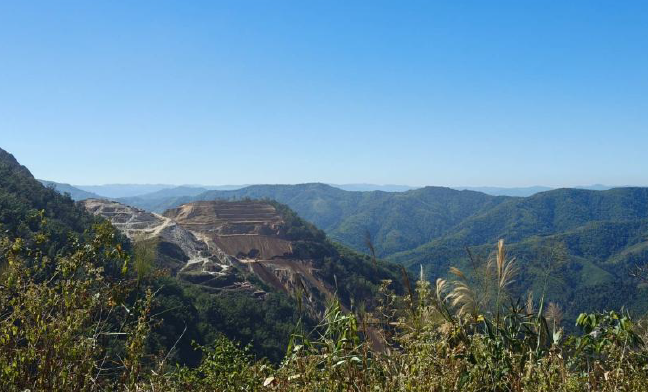
One day, people discovered that the land beneath our village contained a valuable natural resource: lead. Soon after, a company arrived to extract it.
At first, the news sounded like hope.
For the first time, there were job opportunities close to home. Many local people, including my relatives, began working for the company and earning a daily income.
Some villagers said with excitement, "Maybe our village will finally develop. Maybe our lives will become easier."
For a short time, it felt as if development had finally reached our forgotten village.
But the feeling did not last long.
Only five months later, the first signs of trouble appeared.
The clear stream that flowed through our village, the same stream where we once swam and played, became contaminated. The water turned unsafe. We could no longer swim in it or use it to water our farms.
The lowland near the stream slowly turned into a dumping ground where the company discarded unwanted rocks and sand from the mining process.
The green landscape I loved began to lose its color.
Families, including mine, started digging wells to find clean water. Meanwhile, many villagers continued working at the company, doing hard labor to support their households.
At the time, survival felt more urgent than worry.
Then, two years after the mining began, the news arrived that changed everything.
Our entire village was declared unsafe to live in.
We were told we had to leave.
Many villagers could not believe it.
"This is our birthplace," some elders said. "How can we abandon the land where we buried our parents and raised our children?"
For many of us, this land was more than just a location on a map.
It was where we took our first steps. Where we learned to run. Where we hid from chasing dogs and played until sunset.
I could still picture every corner of it—my playground, my secret hiding spots, and the landscapes that filled my childhood drawings.
How could we leave the ground that held so many memories?
Yet we had little choice.
With some compensation from the company, we packed what we could carry and left our home behind.
My family moved to a forested area that felt completely unfamiliar. Some of my friends went to live near their relatives in other towns.
Slowly, the village that once held us together scattered in different directions.
It felt as if my childhood had been broken into pieces and carried away by the wind.
Years have passed since we left.
Sometimes I travel back to my old birthplace.
Each time I visit, I see how much it has changed. The place that once felt like my entire world now looks neglected and wounded. Without proper care, flash floods and landslides strike the area every year, reshaping the land again and again.
Sometimes I stand there quietly, trying to match the landscape before my eyes with the one in my memory.
It is becoming harder each year.
There are no trees left that I can point to and say, "I used to climb that tree."
There is no safe stream where I can show children how we once swam under the hot afternoon sun.
The green scenes that once filled my childhood drawings may one day sound like myths to my own children and grandchildren.
What was once my playground has now become only a story.
And sometimes I wonder:
How many other villages carry stories like mine, places where childhood memories slowly disappear under the weight of development and environmental damage?